.dropdown { font-family: arial; font-size: 120%; color: #000000; width:130px; margin: 5px 0 0px 0px; background-color: #ffffff; } List NINE
Open links in secondary window

Wednesday, April 04, 2007

Asayake: Notes on an Ongoing Workplace Struggle (part 2)

A few quick notes. My comrade Sphinx over at Asayake does a great autonomist/libertarian communist site from Japan in English, primarily. Not that long ago he posted the second part of his analysis of workplace struggle in Japan. Since I linked to the first part a while ago, I thought it would be worthwhile to link to the second half. I posted a comment there about an experience I had in the Postal Workers Union some years back.

His analysis is quite interesting as usual, and focuses on workers resisting the typical organizing strategy of forming their dissatisfaction with workplace conditions into concrete demands and leadership. Sphinx explores the idea of not codifying them and instead resisting upon a broad spectrum of general resistance, with the idea being that a broader, less easily-identifiable (and therefore less easily recuperated or attacked) informal resistance may offer opportunities for advancing workplace struggles and expanding them to other terrain of struggle where common ground can be found. Check it out:

Notes on an Ongoing Workplace Struggle (part 2)

Labels: , , , ,

Monday, January 29, 2007

Asayake: Notes on an ongoing workplace struggle

My homeboy at the blog Asayake has posted the first half of a two part analysis of the modern Japanese workplace. The analysis at this blog is always stellar, and this particular piece is no exception. It's a very interesting look at workers self-organization, the work environment and the bosses' attacks on workers, not to mention the state and methods of workers' struggle in the office and the way that Japanese workers see themselves in relation to the company. I highly recommend checking it out.


An excerpt:
"1. Modern information economy workplaces can be effectively divided between two models. One, the American and European model in which engineers, writers and other employees have separated cubicles, and come together for meetings or collaborative projects. This model maximizes the creativity of the individual worker and the potential for creative intellectual inventorship based on experimentation. This model is also a historical form etched out by post-fordist workers, who often refuse traditional organizations of work, crossing the borders of overtime and worktime and rearranging the spatial organization of the office, disaggregating the assembly line into individualized laboratories. In many workplaces, workers confer and communicate mainly via e-mail, with face-to-face consultation becoming an exception.

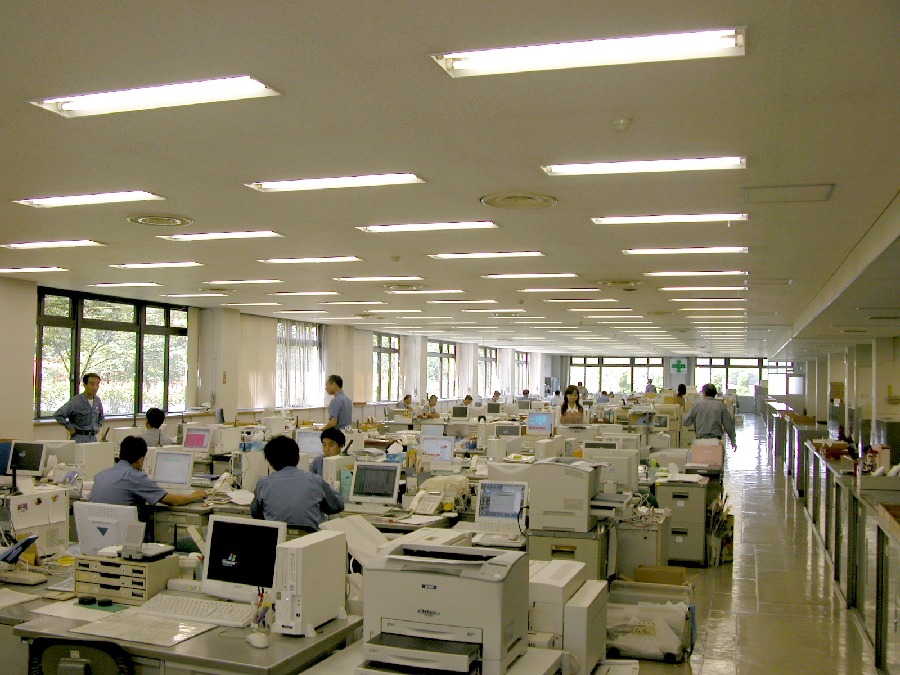
In Japan, the scene is a bit different in that, generally, the post-fordist technology economy does not confront an antagonistic technological proletariat, one not only productive of new technologies but also constantly undermining (and therefore advancing) the parameters of their control and re-thinking the traditional organization of the workplace. Instead, Japanese engineers, technical writers and office workers are grouped into large offices with few partitions. The Japanese office resembles a hall arranged in desk islands, which are always horizontally organized and of low height, providing the supervisor(s) an infinite purview of the workers, their activities and tasks. Any computer screen is potentially subject to review at any moment. E-mail has mostly replaced face-to-face interaction, simultaneously bringing with it the potential for 'silent antagonism', unseen affinities between wage workers that develop over certain circuits with the potential for a larger resonance and even an explosion of dissent."
Continue reading the rest here:

Labels: , ,

Powered by Blogger